


Welkom bij de online catalogus van de aankomende Kunst- & Antiekveiling
Hieronder treft u onze online catalogus aan. Het is een 'Live Online' zaalveiling. Zodra u bent ingelogd kunt u zelf online commissiebiedingen (dus uw maximale bod) plaatsen middels de online catalogus. Dat kan tot één uur voordat van de betreffende zitting de zaalveiling begint. (U krijgt géén melding als uw commissiebod overboden is). De data en aanvangstijden van de zittingen van de 'Live Online' zaalveiling staan bij elk kavelnummer vermeld. Op die tijden kunt u de live stream van de veiling volgen en 'Live Online' meebieden. Tevens is bieden in de veilingzaal mogelijk. U kunt de catalogus sorteren op volgorde van lotnummer of op volgorde van veilingdatum. Tevens kunt u een lijst met favoriete lotnummers maken middels het 'hartjes icoon' afgebeeld bij het lot van uw keuze. Deze favorieten vindt u terug onder de knop Mijn account > Mijn catalogus. Wij wensen u veel plezier bij het bekijken van het veilingaanbod, succes met bieden en hopen u 'Live Online' of in de veilingzaal te mogen treffen.
Sluiten
decorated in relief with birds
h. 48 cm
[2]

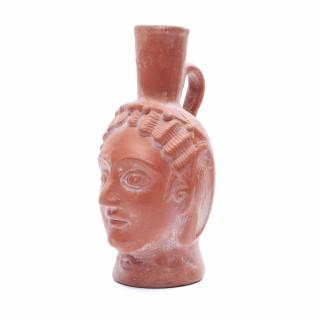
Oinochoe of dark orange-red color, in the shape of a female head. On the upper part of the vessel, near the pouring spout, there is an inscription: "EX OF[ICINO] NAVIGI". The woman has almond-shaped eyes, and her face is framed by wavy hair. She wears a necklace with an eye pendant.
H. 21.8 cm.
Provenance: Private Dutch collection, collected between 1970-1974 by a collector working for the Dutch Ministry of Foreign Affairs, stationed in North Africa.
[1]
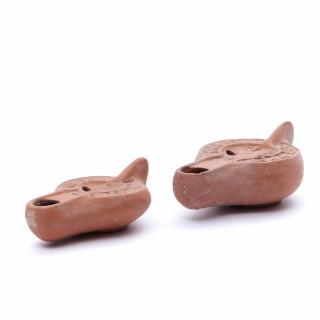
Two mouldmade lamps similar in shape, with round shoulders and a handle. One oil lamp depicts a fish in the center of the discus, with its tail pointed to the front, and it's head facing to the handle. The shoulder shows an alternating pattern of round and triangle ornaments. The second oil lamp is slightly bigger in size. The discus depicts a running horse with a decoration around the neck of the horse. The horse is facing the handle. The shoulder shows an alternating vegetal and circle decoration.
L. 11.6-13.9 cm.
Provenance: Private Dutch collection, collected between 1970-1974 by a collector working for the Dutch Ministry of Foreign Affairs, stationed in North Africa.
[2]
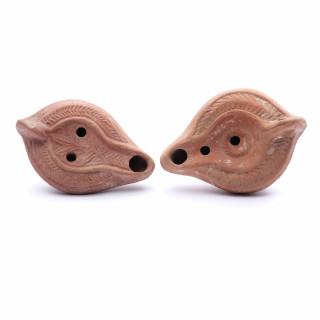
Two mouldmade terra sigillata oil lamps, both with handles at the rear. The discus shows a vegetal decoration, rooting from the front of the lamp, and the surrounding shoulders are ornamented with a fan-shaped vegetal motif. On the bottom of the oil lamp, we read the engraving 'X O' and a decorative palmbranch. The other discus which is a bit broader shaped, has a ring handle at the rear. The discus depicts a small concentric circle in the middle. The shoulders are decorated similarly with a vegetal motif. The bottom of the oil lamp carries an engraving: 'I A H'.
(11.4-11.6 cm)
Provenance: Private Dutch collection, collected between 1970-1974 by a collector working for the Dutch Ministry of Foreign Affairs, stationed in North Africa.
[2]
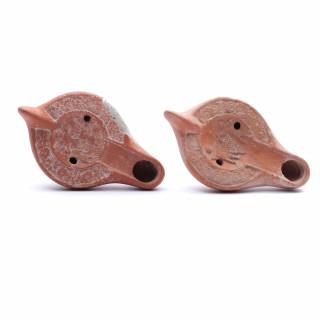
Two Roman Terra Chiara oil lamps, which both have a handle at the rear. The discus shows a well-known Old Testament biblical scene, referred to as 'The Spies of Canaan'. It shows two men carrying a massive cluster of grapes, tied to a stick which the men carry on their shoulders. The shoulder features a motif of vine-scroll pattern. The second discus shows an Old Testament narrative scene from the Book of Daniel, where three Hebrew youths stand before an angelic figure. The shoulder surrounding the central scene shows an alternating rosette and floral pattern.
(14.0-14.2 cm)
Provenance: Private Dutch collection, collected between 1970-1974 by a collector working for the Dutch Ministry of Foreign Affairs, stationed in North Africa.
[2]
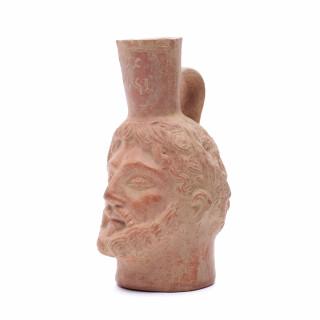
Oinochoe in the shape of a man, with long wavy locks, a short beard, moustache and a small goatee under his lower lip. The pupuils are pointed outward, and the iris is grooved. On the front of the tall cylindrical spout, the manufacturers mark is inscibed:'EX OF / NAVIGII', divided over two lines. The handle is broad, and is decorated with vertical grooves.
(H. 17 cm)
Provenance: Private Dutch collection, collected between 1970-1974 by a collector working for the Dutch Ministry of Foreign Affairs, stationed in North Africa.
[1]

A collection of four Roman oil lamps in terra sigillata, each featuring a decorated discus with a cross or Christogram (Chi-Rho) motif. The shoulders are ornamented with a variety of geometric and floral designs, including triangles, squares and rosettes. All four lamps are provided with a handle. One lamp is slightly smaller than the others and is distinguished by its light brown coloe. The remaining lamps are more typical reddish terra sigillata coloured.
(L. 13.1-14.5 cm)
Provenance: Private Dutch collection, collected between 1970-1974 by a collector working for the Dutch Ministry of Foreign Affairs, stationed in North Africa.
[4]
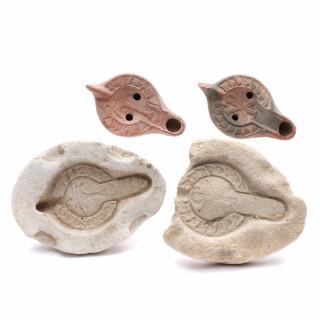
A pair of Roman mould-made oil lamps, each with an upper mould half. The moulds represent the upper portions of the lamp, including the discus, shoulders and handle. The first lamp depicts a Chi-Rho motif on the discus. The shoulders are decorated with a repeating pattern of small triangular or spade-shaped motifs. The lamp is slightly fire-blackened, due to chemical processes in the process. The corresponding mould is partially broken at the end of the handle. The second lamp features a palm motif on the discus. The shoulders are decorated with a combination of floral and geometrical motifs. The pairing of a lamp with mould shows both the finished product and the tool used in its manufacture.
L. 15.5-18.7 (moulds)
Provenance: Private Dutch collection, collected between 1970-1974 by a collector working for the Dutch Ministry of Foreign Affairs, stationed in North Africa.
[2]
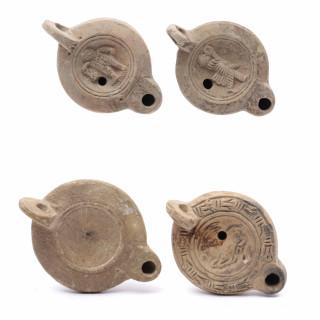
A collection of four Roman oil lamps in terracotta, ranging in colour from grey to reddish-brown. All four lamps are provided with a pierced rear handle. One lamp is plain and undecorated, with a smooth discus and shoulders. The second lamp is decorated with small linear strokes on the shoulder. The discus also appears to depict a decoration/scene with a similar technique. The bottom of these oil lamps carry inscriptions: 'MAVR ICI' and SABBA TI'. The remaining two lamps each feature a figural depiction on the discus. One discus shows a walking figure, while the second discus shows a figure holding something with an outstreched arm. The bottom of these firm-lamps carry the firm: 'MNOVIVST' and 'IVNORAC'.
(L. 10-11.2 cm)
Provenance: Private Dutch collection, collected between 1970-1974 by a collector working for the Dutch Ministry of Foreign Affairs, stationed in North Africa.
[4]
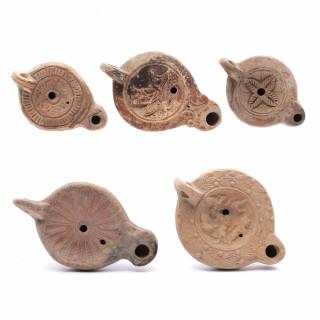
A collection of five Roman oil lamps in terracotta. Two of the lamps are of smaller size. The first has a floral motif on the discus. This oil lamp carries a firm inscription on the bottom: 'MNOVIVS'. The second is decorated with incised strokes arrounged on the shoulders, and a same decoration in a more irregular pattern on the discus. The third lamp, slightly bigger in size, has a discus depicting a composition of elongated oval shapes around the center of the oil lamp. The remaining two lamps are biggest in size, and are depicting figural scenes. One discus shows a human figure surrounded by lions. The shoulders have vegetal decorations. The other oil lamp shows two male figures, possibly in a boat, one of whom appears to be attacked by an animal. The scene may be a narrartive or mythological episode. This oil lamp carries a firm insciption on the bottom: 'LMADIBC'.
(L. 9.8-12.6 cm)
Provenance: Private Dutch collection, collected between 1970-1974 by a collector working for the Dutch Ministry of Foreign Affairs, stationed in North Africa.
[5]
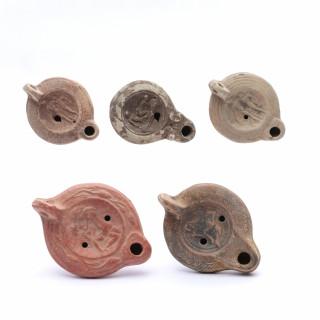
A collection of five Roman Oil Lamps, varying in size and colour from light to darker reddish-brown tones. The scenes on the discus depict nude or erotic encounters, with varying degrees of preservation. One lamp preserves a particular clear scene of two figures engaged in sexual intercourse. The remaining lamps feature nude figures in erotic or standing poses, although the details are less clearly preserved. The shoulders are variously decorated, plain or with decorative motifs such as stripes. The group illustrates the presence and variety of erotic imagery in Roman lamp decorations, with the discus providing the principal surface for the figural scenes.
L. 9.2-12.5 cm
Provenance: Private Dutch collection, collected between 1970-1974 by a collector working for the Dutch Ministry of Foreign Affairs, stationed in North Africa.
[5]
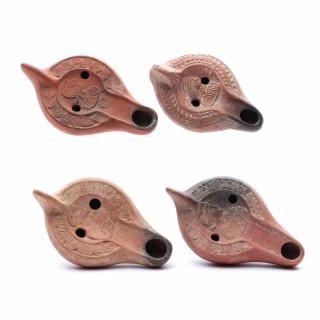
Four Tunisian terra chiara Roman oil lamps, dated to the 2nd–5th century CE, are decorated on the discus with figural motifs depicting individuals in side profile. The first lamp features a profile bust wearing what appears to be a helmet or close-fitting cap, with the shoulders ornamented by stamped geometric designs and concentric-circle motifs. The second depicts an apparently female figure in profile, distinguished by an elaborate headdress and jewellery, including a necklace around the neck. The third shows a profile figure with long, stylized hair falling vertically down the back of the neck; the torso is adorned with a patterned garment or jewellery incorporating circular and geometric motifs, while the face is rendered schematically with a prominent nose and simplified eye. The fourth lamp depicts a figure in profile with typically Roman-style hair and draped clothing. Across the four lamps, the figures are emphasized in their hairstyle or headdress, and are decoratively dressed in garments.
L. 12.4-14.5 cm
Provenance: Private Dutch collection, collected between 1970-1974 by a collector working for the Dutch Ministry of Foreign Affairs, stationed in North Africa.
[4]

Five half moulds for the upper part of Roman oil lamps, showing the discus and shoulder decorations. Three half-moulds are intact, while two are broken at the end of the handle. The decoration on two of the discuses is poorly preserved and the original figural or ornamental scenes cannot be securely identified. The remaining three moulds retain clearer decorative schemes. One discus depicts two birds perched on a vase facing one another, while the shoulders are decorated with triangular motifs and spade-shaped elements. A second discus depicts a large fish, oriented towards the rear of the lamp, facing the handle. The third bears an ornamental geometric composition consisting of two superimposed squares, decorated internally with patterned motifs; their overlapping arrangement produces an eight-pointed, star-like form. The shoulder decoration and the geometric compositions provide a varied ornamental treatment across the five moulds.
(L. 15.3-19 cm)
Provenance: Private Dutch collection, collected between 1970-1974 by a collector working for the Dutch Ministry of Foreign Affairs, stationed in North Africa.
[5]
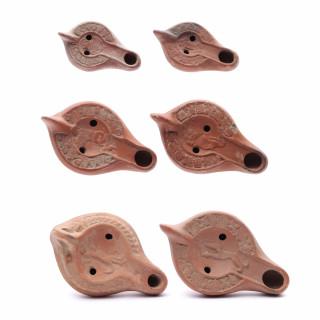
A collection of Tunisia Terra Chiara Roman Oil Lamps varying in size, and decorated with a range of figural and ornamental motifs. Four of the lamps depict animals on the discus, including two scenes with a running dog. One of these depicts a dog pursuing a rabbit. The second discus shows a dog running alone, characterized by its prominently enlarged ears. They are both rendered in profile and in motion. A third lamp depicts a reclining lion, beside a small plant or tree. The fourth animal scene shows a running lion or boar, the precise identification is uncertain. The two smaller lamps bear different motifs: one depicts a side profile of a figure, wearing a headdress or ornamented hairstyle and neck jewellery, while the other features an architectural motif in the form of a column or pillar. Four of the six lamps have decorated shoulders, incorporating a variety of geometric and vegetal motifs, including triangles, floral designs, spade-shaped elements, and teardrop-shaped forms.
L. 10-14.5 cm
Provenance: Private Dutch collection, collected between 1970-1974 by a collector working for the Dutch Ministry of Foreign Affairs, stationed in North Africa.
[6]
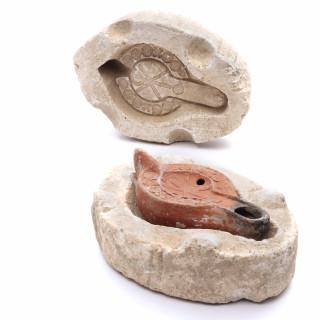
A rare complete gypsum mould, comprising both the upper and lower halves, accompanied by the terra chiara Roman oil lamp produced from the mould, dating to the 3rd–5th century CE. The survival of the complete mould together with its corresponding finished lamp provides an exceptional opportunity to observe the relationship between the mould and the end product. The decorative details of the discus and shoulders are exceptionally well preserved and clearly visible on both the mould and the lamp. The discus of the lamp bears the Christogram, or Chi-Rho (XP), as its central motif. The shoulders are ornamented with concentric-circle motifs, while two floral or clover-shaped motifs are positioned centrally on either side of the lamp. The sharp preservation of the relief decoration in both the mould and the finished lamp provides a particularly clear example of the production technique and decorative motifs of Tunisian terra chiara oil lamps.
L. 20.2 (mould) &13.6 (Oil Lamp)
Provenance: Private Dutch collection, collected between 1970-1974 by a collector working for the Dutch Ministry of Foreign Affairs, stationed in North Africa.
[2]
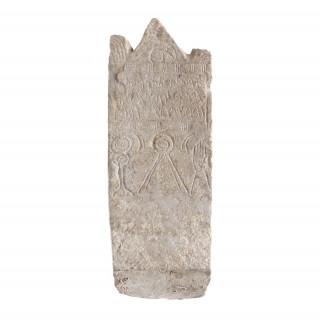
The carved relief on this Punic limestone stele reflects distinct religious and artistic traditions
of ancient Carthage. The central engraving features a prominent triangle surmounted by a
horizontal bar and a circle. This is the canonical ‘ Sign of Tanit’, a stylized geometric symbol
representing Carthage’s chief goddess, Tanit. It is widely interpreted by scholars as an
anthropomorphic representation of the goddess with her arms outstretched in blessing,
protection, or prayer. At the ‘sign of Tanit’s’ right side, the emblem of the raised right hand is
positioned. At the signs’ left side, The caduceus has a tree-like shaft incised less deeply and
with only a single line, spreading at the base.
In the upper part of the stele there is a crescent moon depicted, symbolizing the heavens
and highlighting Tanit’s role as powerful lunar deity. The stele is shaped in a pillar like form,
with at the upper end a triangular shape.
H. ca. 35 cm.
Provenance: Private Dutch collection, collected between 1970-1974 by a collector working for the Dutch Ministry of Foreign Affairs, stationed in North Africa.
[1]
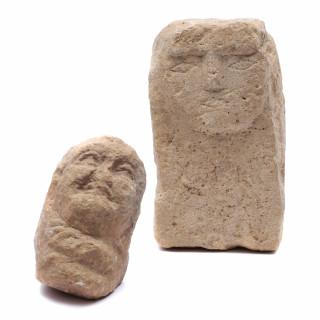
Possibly these two stone fragments were collected when the collector was in Syria, in the early 1970's.
h. 22,5 and 14 cm.
Provenance: Private Dutch collection, collected between 1970-1974 by a collector working for the Dutch Ministry of Foreign Affairs, stationed in North Africa.
[2]
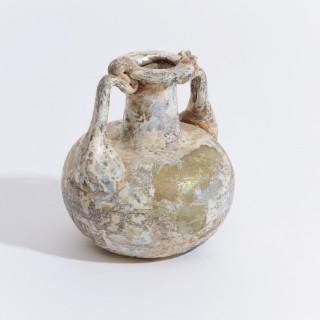
A globular, bulbous body made of pale green, translucent glass. The glass bears a silvery-white iridescence. Two applied strap handles run from the shoulder to the collar rim. One of the handles is double-strapped. Both handles rest folded over the rim.
H. 8.6 cm
Provenance: Private Dutch collection, collected between 1970-1974 by a collector working for the Dutch Ministry of Foreign Affairs, stationed in North Africa.
[1]
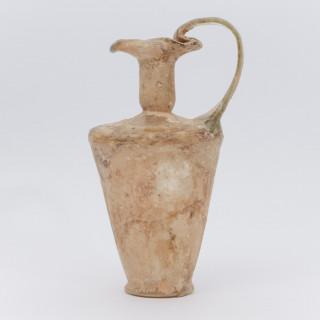
A fine Roman translucent light-green glass jug. The vessel features an ovoid body, tapering downward to a flat, stable base. The broad, slightly sloping shoulder runs sharply into a tall cylindrical neck. The neck flares outward into an elegant funnel-shaped mouth, while the rim is turned-out, designed for clean pouring. A single, thick glass handle is applied directly to the shoulder, drawn gracefully upward and outward in a wide curve, and attached to the underside of the rim.
(H. 20.9 cm)
Provenance: Private Dutch collection, collected between 1970-1974 by a collector working for the Dutch Ministry of Foreign Affairs, stationed in North Africa.
[1]
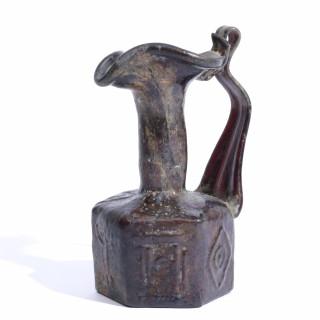
A rare Roman aubergine collored glass featuring a hexagonical body divided into six distinct rectangular panels. The body transitions into a gently sloping shoulder, a tall cylindrical neck, and a flared trefoil mouth with a slightly folding rim. The handle is applied to the edge of the shoulder, where it sharply folds into the rim, and functions as a stylized thumb-rest. Each of the six body panels are decorated with symbolic imagery. On the front and the rear panel, a menorah is depicted. The other panels depict The Ark of the Covenant, and an eye symbol in a Lozenge shape.
H. 12 cm
Provenance: Private Dutch collection, collected between 1970-1974 by a collector working for the Dutch Ministry of Foreign Affairs, stationed in North Africa.
[1]
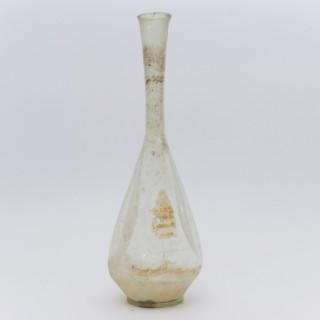
This Roman glass with a pale light-green translucence is characterized by an elongated pear-shaped body with a flattened base. The body transitions into a tall, narrow cylindrical neck that flares out at the top into a simple, slightly out-turned rim.
(H. 28.7 cm)
Provenance: Private Dutch collection, collected between 1970-1974 by a collector working for the Dutch Ministry of Foreign Affairs, stationed in North Africa.
[1]
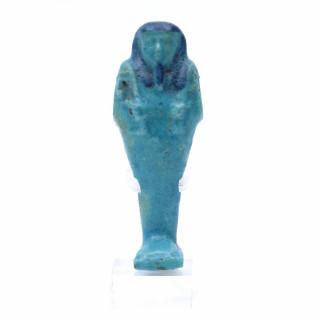
holding a pick and a hoe, painted in dark blue accents.
h. 11 cm. mounted.
[1]

A large, cylindrical transport amphora with a heavy body and two strong, opposing handles extending from the narrow neck to the broader shoulder. The body tapers into a solid, pointed toe. The exterior surface displays chalky, whitish encrustations. This type of amphora was widely utilized for the bulk maritime transport and storage of liquid commodities such as olive oil or wine.
h. 112 cm.
Provenance: Private Dutch collection, collected between 1970-1974 by a collector working for the Dutch Ministry of Foreign Affairs, stationed in North Africa.
[1]
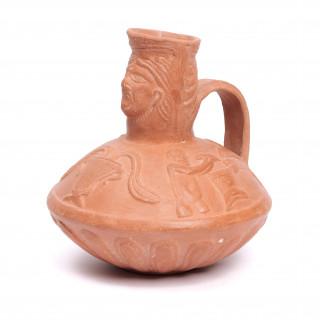
with relief decorations of three satyr figures, a overflowing wine vessel and a swan figure. The neck decorated with a portret of a bearded satyr.
h. 16,5 cm.
Published in Babesch, no. 55, Part 1, 1980. image 16a-b. Private collection The Hague, Holland.
[1]
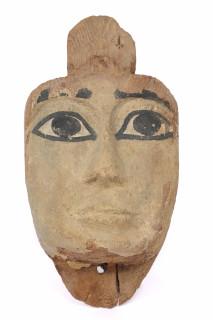
with layers of paint and the eyes and brows painted in black. At both ends of the mask an extension for attachments.
L. 17,5 cm.
Private Dutch collection, 1980's.
[1]
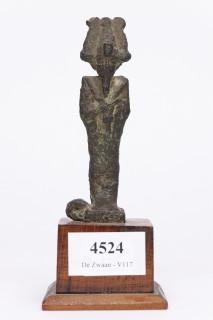
presumably depicting "Osiris", in shape of a pharaoh with "atef" crown, crook (symbol of the good shepard) and flail (symbol of fertility). He is commonly depicted green (the color of rebirth) or black (alluding to the fertility of the Nile floodplain), in mummiform, wearing the trappings of mummification from chest downward.
h. 12 cm. on wooden base
Provenance: Private Berlin Collection.
[1]
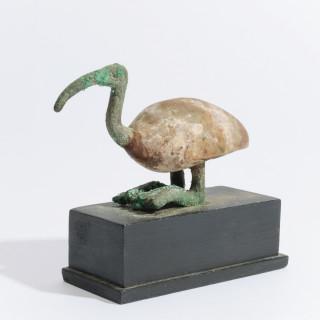
a clay boddy and with eroded bronze feet and head.
L. 10 cm. mounted
Provenance: collection Dr. Stoutenbeek and Chris Leeflang, late 1950's - early 1960's.
[1]
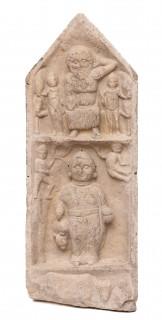
In this stele, a large-sized standing stone with the topside ending in a triangle shape, we see
three distinct relief scenes.
In the center, standing on a ground floor, is a woman facing forward with a broad, flat face
and hair combed tightly back. She holds a pomegranate in her left hand and three distinct
objects in her right, difficult to identify. In Greek and Roman mythology, the pomegranate
was associated with fertility and the enduring nature of marriage (Yılmaz, Akkemik, and
Karagöz 2013). She is depicted wearing a tunic and mantle, their folds articulated through
carved lines across the stone surface, and is adorned with earrings and a necklace. Her big,
almond eyes catch the gaze of the viewer. Her nose has been damaged. To her right, in the
top corner, stands a putto in a palm tree holding a wreath in his left hand. To her left, a
floating putto holds palm branches.
In the upper panel, above this scene, sits a male figure facing forward; he has a broad face
framed by curls and a full beard, with his left hand behind his head and his right hand,
possibly holding a cornucopia (a symbol of plenty consisting of a goat's horn overflowing with
flowers, fruit, and corn) resting on his knee. His upper body is nude, and a mantle is draped
around the back of his head and his lower body. He is depicted seated with his legs spread
apart and wearing sandals. The figure represents Saturn. A palmette appears behind his
head (an ornamental motif based on the spreading fronds of the palm tree).
Saturn was a particularly important deity in Roman North Africa, and his image appears on
North African stelae (Schörner 2007). Saturn's cult developed from the earlier worship of the
Punic and indigenous god Baal (Wilson 2004). On either side stands a horseman holding a
whip and leading his horse. They are dressed in short mantles and pointed caps (the
Dioscuri). The Dioscuri were twin demi-god protectors of sailors and patrons of horsemen
and races, depicted as a pair of naked youths, wearing traveller's capes and egg-shaped
caps, and with a horse or horse's head by their side (Theoi Greek Mythology, “Dioscuri
Cult”).
The bottom scene depicts a bovine, with a boy in front holding a sheaf of grain(?)
(Rijksmuseum van Oudheden 1975, object 90).
Roman funerary monuments should not be understood solely as
markers of a grave, but also as material carriers of memoria. The monument served as a
means of ensuring the deceased’s continued presence among the living (Schörner 2007).
h. 90, w. 33,5 and d. 10 cm.
Provenance: Private Dutch collection, collected between 1970-1974 by a collector working for the Dutch Ministry of Foreign Affairs, stationed in North Africa.
[1]
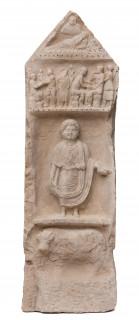
The stele has a long, rectangular shape, at the topside ending in a (triangle) fronton. The stele shows four distinct relief scenes. The middle scene depicts a frontal, standing man on a ground surface. His broad face is flat, framed by curls, and he is dressed in a toga and cloak, decorated with engraved zig-zag patterns, which he holds in his right hand. His left hand is extended and holds an object, which is partially broken off and thus unidentifiable. He wears bracelets and a necklace, with lunula identified by Rijksmuseum van Oudheden (Rijksmuseum van Oudheden 1975, object 91). This crescent moon pendant (lunula) was used as an amulet for protection against the evil eye (Museo de Ecología Humana, “Amulets in Rome”). On both sides of the figure's head are two dolphins engraved, wrapped around a scepter. The relief scene is divided by the ‘floor’ of the scene above, decorated with a wave/zigzag motif and small perforations. The panel above depicts the story of the birth of Dionysus from the thigh of Zeus. At the outer right side, the scene shows how Dionysus is born from Zeus’ thigh, with Hera standing behind him. At the left side, Hermes stands ready to cover him with a panther skin and deliver him to the nymph Nysa who raised him in the mountains (Vatican Museums, “Relief with the Image of the Scene of Dionysos’ Birth”) . In the upper part of the stele, the fronton is separated from the scene below by a braided band. Within the fronton, a woman draped in a cloak reclines against an acanthus leaf, supporting herself on her left arm. In the Greek and Roman world, the acanthus plant was associated with concepts such as life, immortality, the crescent moon, and the appreciation of the arts (Yılmaz, Akkemik, and Karagöz 2013). Above her floats a bearded half-figure, dressed in a cloak. The bottom scene depicts a standing bovine, but is eroded/damaged. Roman funerary monuments should not be understood solely as markers of a grave, but also as material carriers of memoria. The monument served as a means of ensuring the deceased’s continued presence among the living (Schörner 2007).
h. 104, w. 32 and d. 11,5 cm.
Provenance: Private Dutch collection, collected between 1970-1974 by a collector working for the Dutch Ministry of Foreign Affairs, stationed in North Africa.
[1]

the handle decorated with a vine in relief, ending at the bottom in a bearded head of a silenos, at the top a projecting palmette and ending on the mouth opening in two duck heads. The underside decorated with several concentric circles in relief.
h. 19,2 cm.
Provenance: Professor Blankaart, The Hague, Holland.
[1]
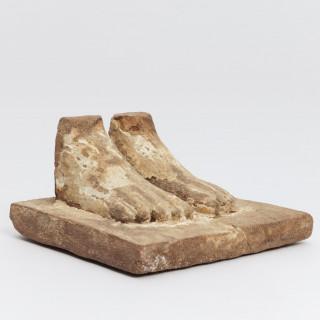
with remants of pigments and, lime and gold leaf.
7,6 x 7,2 and h. 3,8 cm.
[1]
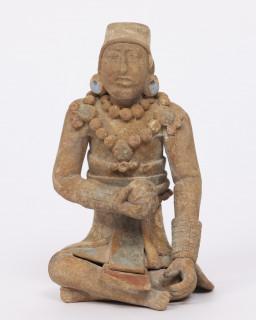
wearing a scull necklace and holding a ball. With natural blue, red, white and brown pigments.
h. 12,5 cm.
Provenance: Nico Bunschoten, Amsterdam, before 1979. Private Dutch collection, Utrecht.
[1]
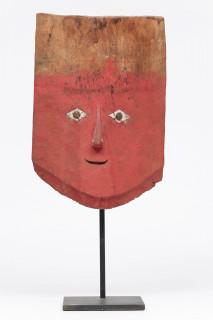
with carved rhombic shaped eyes, lime stone white and pupils from plant paste. Painted in red.
h. 28 cm. custom metal stand
Provenance: America Antigua, Tilburg. Private Amsterdam collection.
[1]
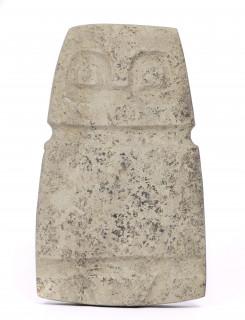
trapazoidal shaped with incised lines forming the eyes and legs. With dentrite deposits.
h. 19 cm. mounted
Provenance: Private New York collection USA. Arte Primitivo, NY, USA and private Dutch collection
[1]
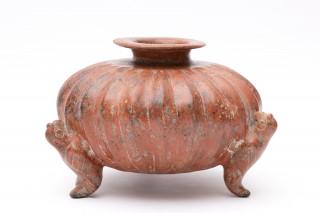
the body shaped as a fruit, the legs shaped as three parrots.
diam. 33 and h. 22 cm.
Provenance: Arte Primitivo, New York, USA. Private Dutch collection.
[1]
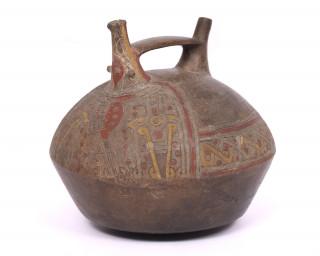
with engraving of two aquatic animals and an ardvark, with its boddy engraved, its snout protruding as a part of the spout. With red and oker collors.
diam. 19,5 and h. 18 cm.
Provenance: Collected by Proff. M. Boenders, while stationed Lima, Peru, between 1967-1971. Private Dutch collection by descent.
[1]
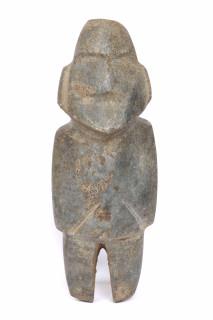
with spots of deposit.
h. 17,6 cm.
Provenance: Nico Bunschoten, Amsterdam, prior to 1979. Private Dutch collection, Utrecht.
[1]

with a fine modeled face, accents painted in brown slib.
h. 65 cm.
Provenance: Nico Bunschoten, Amsterdam, prior to 1979. Private Dutch collection, Utrecht.
[1]
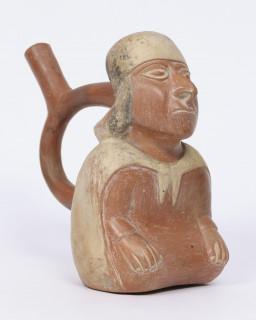
in the shape of a seated priest figure.
h 21,5 cm.
Provenance: Nico Bunschoten, 1979. Private Utecht collection.
[1]
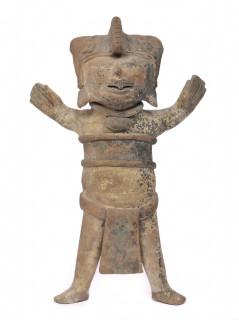
with remnants of polychrome pigments.
h. 20 cm. mounted.
Provenance: Ursula Voorhuys, Nijmegen, april 1974. Private Dutch collection, Utrecht.
[1]

decorated with thirteen Uraeus snakes with a Sun disk in relief.
h. 8,3 and L. 24,7 cm.
Collected 1970's; The Aldo and Hannie van Eyck Collection
[1]
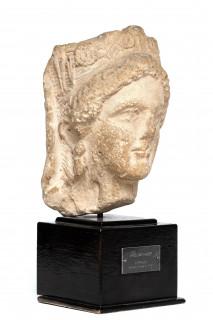
The woman’s head of exceptional size shows an oval face with a subtle smile and a rounded chin. Her big naturalistic eyes, above which her brows are arching, move away from the preceding archaic period, and invite the viewer to gaze at her frontal face. The subtle deviation from the strictly frontal pose, with her head slightly turning to the right, creates a dynamic relationship with the viewer, while maintaining visual engagement. A band of curly hair frames her small forehead, leaving the ears visible on either side of the head. She is wearing elaborate earrings. The woman is wearing a kalathos-shaped headdress, representing a votary/priestess, a deity, or a woman of higher status. The upper part of the kalathos is missing, but the headdress is ornamented with three nude female figures: one at the centre and one at each outer end. Between the central and lateral figures, the decoration consists of an alternating sequence of four rosettes and four foliate ornaments. A veil is attached to the kalathos and falls around the back of the head. The sculpture is damaged at the neck and along the back, where the veil is partially broken away. Sculpture in Cyprus developed largely in connection with religious and civic functions and was closely associated with the construction of temples, palaces, and public buildings. Although the island lacks marble, it is rich in clay and soft limestone, materials that were particularly suitable for sculptural production. Cypriot sculptors learned early on to make effective use of these locally available resources (Spiteris 1970, 180). Already during the Neolithic period, alongside stone idols, evidence appears for the early development of clay and limestone working and the emergence of skilled artisans (Spiteris 1970, 182). By the seventh century BCE, these developments had contributed to highly sophisticated techniques in monumental sculpture. Sustained contact with Cyprus’s eastern neighbours, as well as their presence on the island from the seventh century onward, played an important role in the transmission of artistic knowledge and ideas. The limited availability of hard stone presented a particular technical challenge. The soft limestone found on Cyprus is susceptible to deterioration when exposed to moisture, requiring sculptors to adapt their methods to the properties of the material. They generally worked in a relatively flat manner,limiting the number of carving stages while efficiently exploiting the broad front and back surfaces of the stone (Spiteris 1970, 184).
h. 31,7 ; w. 20 and d. 18 cm. on a custom black painted wooden stand.
Provenance: Private Dutch collection early 1970's. Private Haarlem collection, inherited by descent. Published Rijksmuseum van Oudheden. Klassieke kunst uit particulier bezit: Nederlandse verzamelingen 1575–1975. Tentoonstellingscatalogus nr. 10. Leiden: Rijksmuseum van Oudheden, 1975, cat. 57. Exhibited Rijksmuseum van Oudheden, 1975, Leiden Amsterdam.
[1]

restored lower right corner.
h. 17,5 cm.
Provenance: Private Dutch collection, collected between 1970-1974 by a collector working for the Dutch Ministry of Foreign Affairs, stationed in North Africa.
[1]
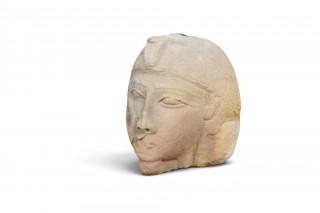
h. 32 cm.
Provenance: Old Dutch family collection.
[1]
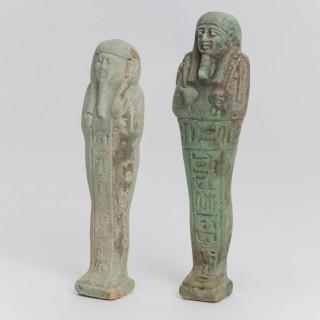
both with hieroghlyps, one with clearer depiction.
h. 13,1 and 11,7 cm.
Provenance: Dutch private collection, 1980's-1990's.
[2]
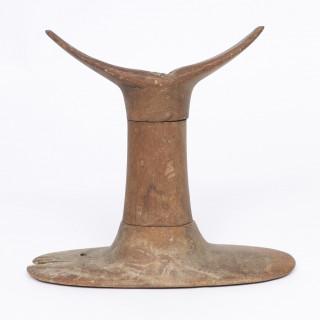
L. bottom 22,5 and h. 21,5, the saddle L. 17,5 cm.
Provenance: Private Dutch collection, collected between 1954-1975.
[1]

L. 10,8 cm.
Provenance: Hadji Baba Museum, Jerusalem, 1982; The Aldo and Hannie van Eyck Art Collection
[1]
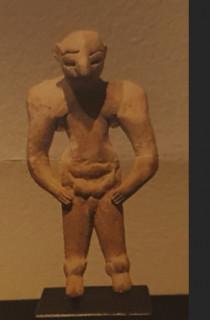
h. 7 cm. mounted.