
 Back to catalogue
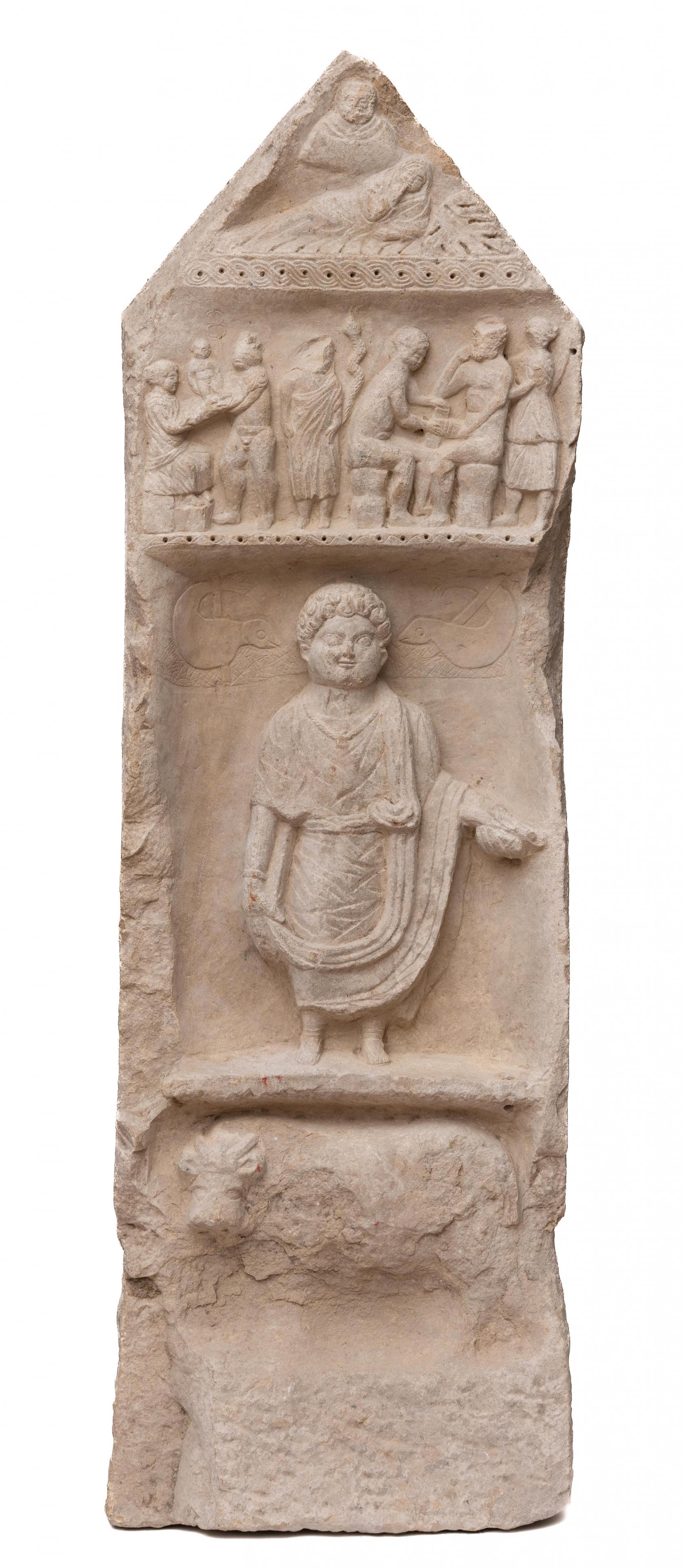
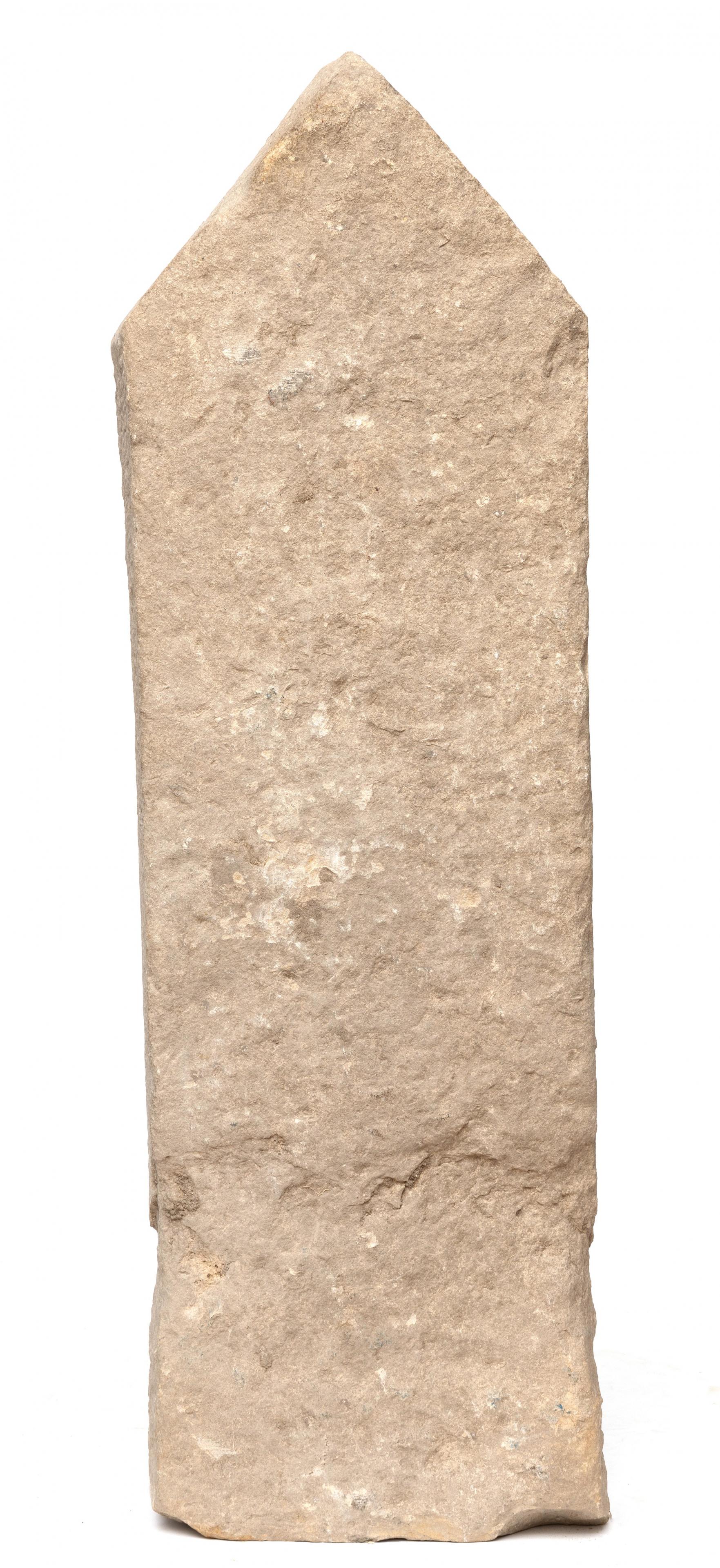
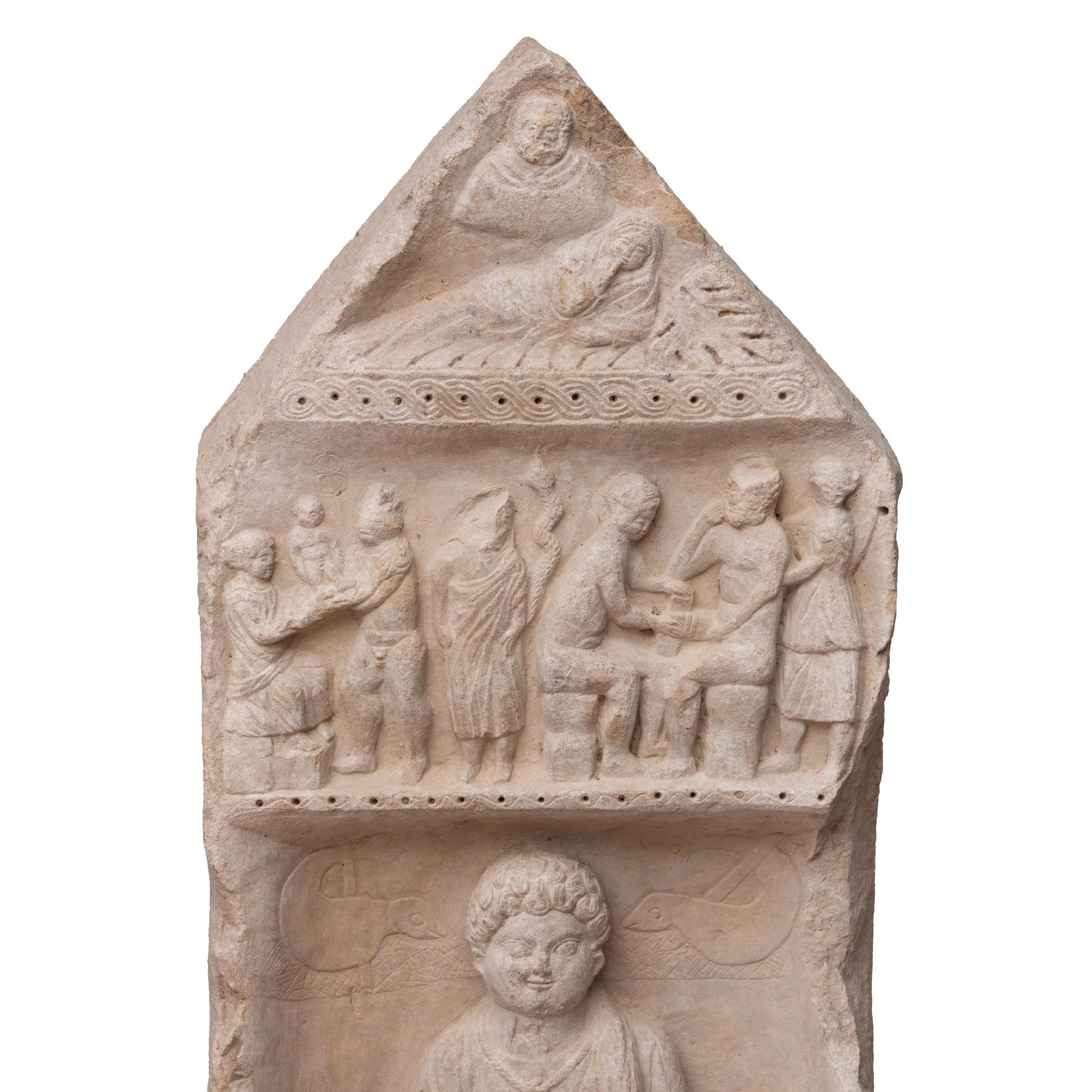
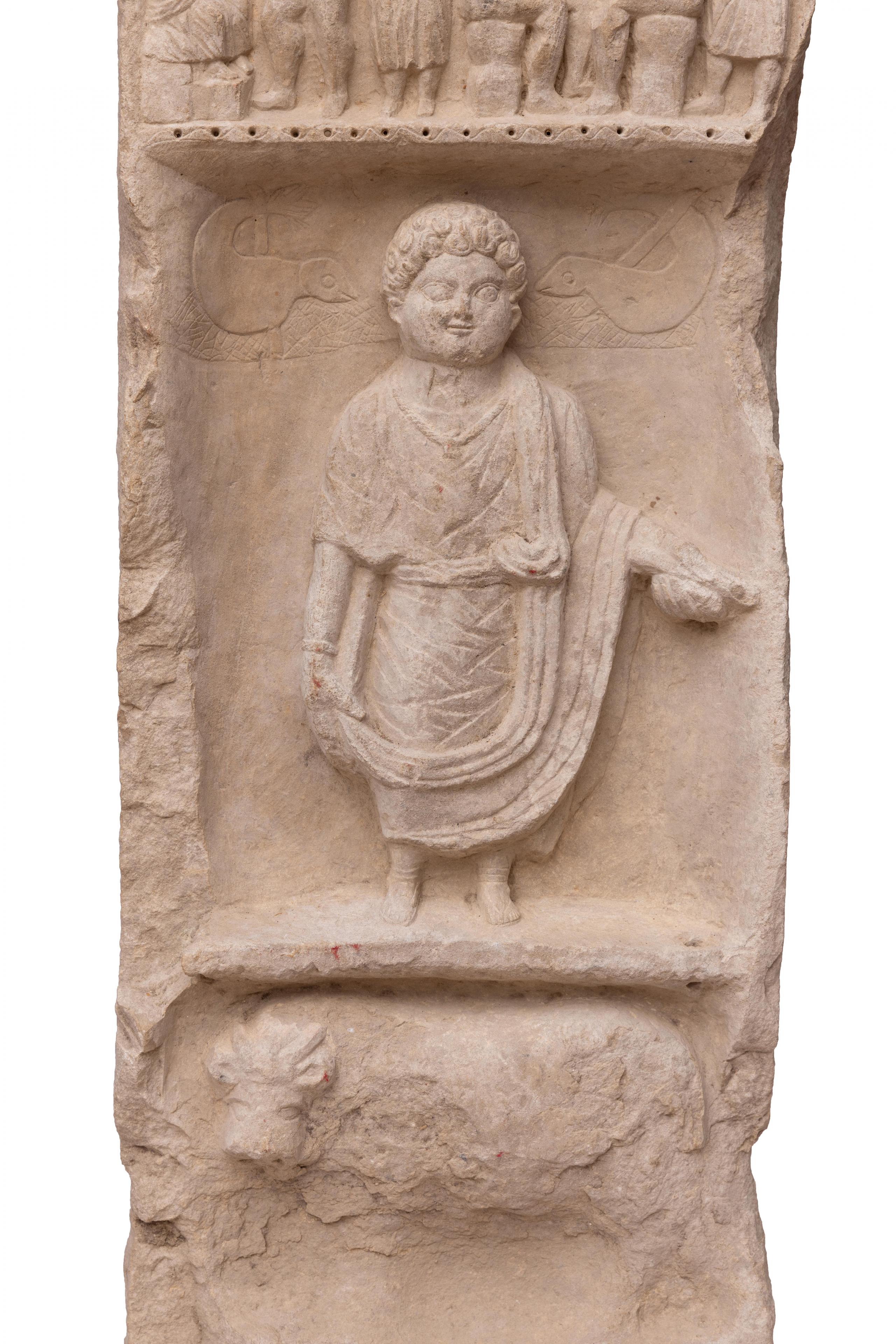

The stele has a long, rectangular shape, at the topside ending in a (triangle) fronton. The stele shows four distinct relief scenes. The middle scene depicts a frontal, standing man on a ground surface. His broad face is flat, framed by curls, and he is dressed in a toga and cloak, decorated with engraved zig-zag patterns, which he holds in his right hand. His left hand is extended and holds an object, which is partially broken off and thus unidentifiable. He wears bracelets and a necklace, with lunula identified by Rijksmuseum van Oudheden (Rijksmuseum van Oudheden 1975, object 91). This crescent moon pendant (lunula) was used as an amulet for protection against the evil eye (Museo de Ecología Humana, “Amulets in Rome”). On both sides of the figure's head are two dolphins engraved, wrapped around a scepter. The relief scene is divided by the ‘floor’ of the scene above, decorated with a wave/zigzag motif and small perforations. The panel above depicts the story of the birth of Dionysus from the thigh of Zeus. At the outer right side, the scene shows how Dionysus is born from Zeus’ thigh, with Hera standing behind him. At the left side, Hermes stands ready to cover him with a panther skin and deliver him to the nymph Nysa who raised him in the mountains (Vatican Museums, “Relief with the Image of the Scene of Dionysos’ Birth”) . In the upper part of the stele, the fronton is separated from the scene below by a braided band. Within the fronton, a woman draped in a cloak reclines against an acanthus leaf, supporting herself on her left arm. In the Greek and Roman world, the acanthus plant was associated with concepts such as life, immortality, the crescent moon, and the appreciation of the arts (Yılmaz, Akkemik, and Karagöz 2013). Above her floats a bearded half-figure, dressed in a cloak. The bottom scene depicts a standing bovine, but is eroded/damaged. Roman funerary monuments should not be understood solely as markers of a grave, but also as material carriers of memoria. The monument served as a means of ensuring the deceased’s continued presence among the living (Schörner 2007).
h. 104, w. 32 and d. 11,5 cm.
Provenance: Private Dutch collection, collected between 1970-1974 by a collector working for the Dutch Ministry of Foreign Affairs, stationed in North Africa.
[1]
