
 Back to catalogue
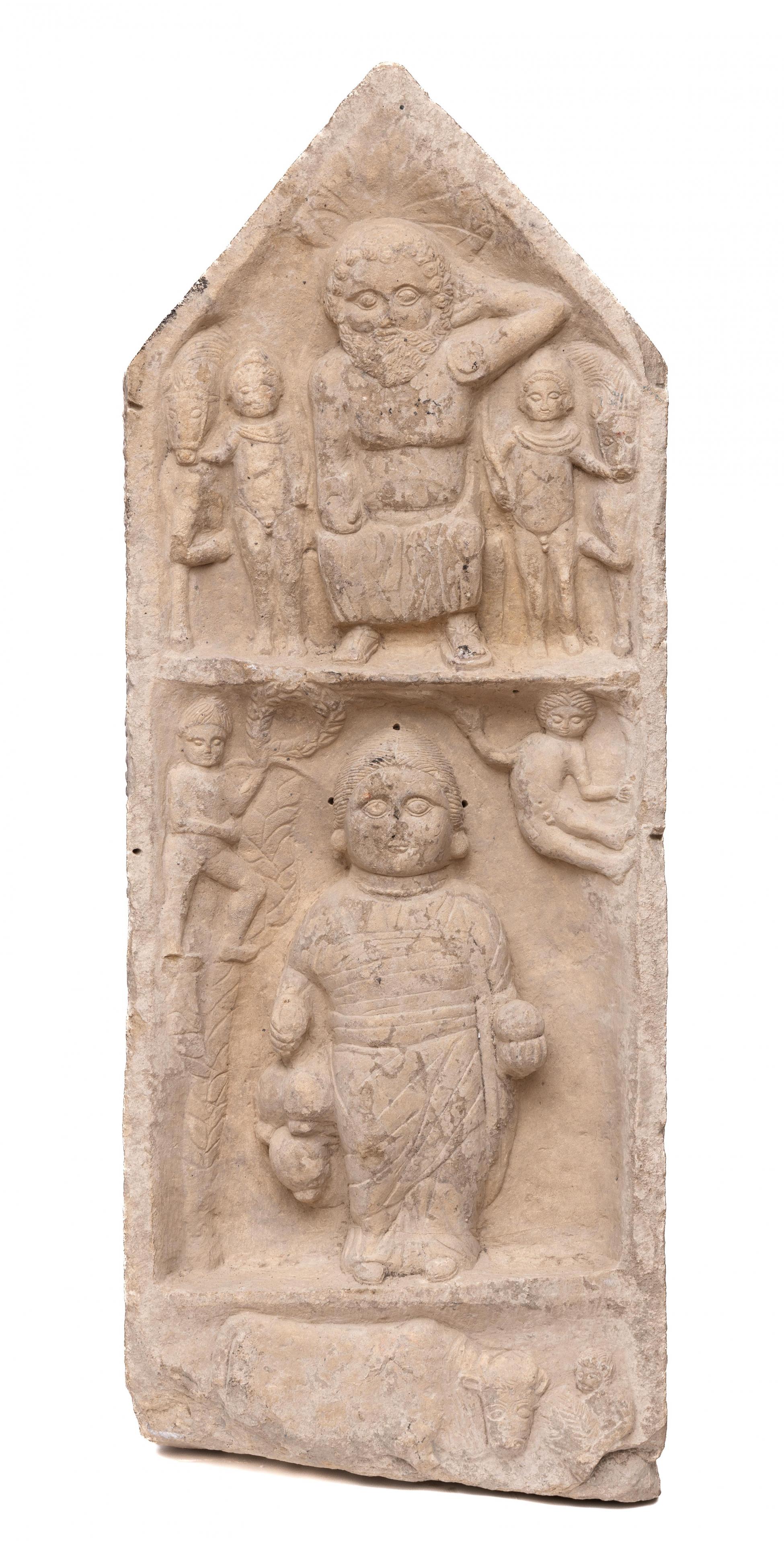


In this stele, a large-sized standing stone with the topside ending in a triangle shape, we see
three distinct relief scenes.
In the center, standing on a ground floor, is a woman facing forward with a broad, flat face
and hair combed tightly back. She holds a pomegranate in her left hand and three distinct
objects in her right, difficult to identify. In Greek and Roman mythology, the pomegranate
was associated with fertility and the enduring nature of marriage (Yılmaz, Akkemik, and
Karagöz 2013). She is depicted wearing a tunic and mantle, their folds articulated through
carved lines across the stone surface, and is adorned with earrings and a necklace. Her big,
almond eyes catch the gaze of the viewer. Her nose has been damaged. To her right, in the
top corner, stands a putto in a palm tree holding a wreath in his left hand. To her left, a
floating putto holds palm branches.
In the upper panel, above this scene, sits a male figure facing forward; he has a broad face
framed by curls and a full beard, with his left hand behind his head and his right hand,
possibly holding a cornucopia (a symbol of plenty consisting of a goat's horn overflowing with
flowers, fruit, and corn) resting on his knee. His upper body is nude, and a mantle is draped
around the back of his head and his lower body. He is depicted seated with his legs spread
apart and wearing sandals. The figure represents Saturn. A palmette appears behind his
head (an ornamental motif based on the spreading fronds of the palm tree).
Saturn was a particularly important deity in Roman North Africa, and his image appears on
North African stelae (Schörner 2007). Saturn's cult developed from the earlier worship of the
Punic and indigenous god Baal (Wilson 2004). On either side stands a horseman holding a
whip and leading his horse. They are dressed in short mantles and pointed caps (the
Dioscuri). The Dioscuri were twin demi-god protectors of sailors and patrons of horsemen
and races, depicted as a pair of naked youths, wearing traveller's capes and egg-shaped
caps, and with a horse or horse's head by their side (Theoi Greek Mythology, “Dioscuri
Cult”).
The bottom scene depicts a bovine, with a boy in front holding a sheaf of grain(?)
(Rijksmuseum van Oudheden 1975, object 90).
Roman funerary monuments should not be understood solely as
markers of a grave, but also as material carriers of memoria. The monument served as a
means of ensuring the deceased’s continued presence among the living (Schörner 2007).
h. 90, w. 33,5 and d. 10 cm.
Provenance: Private Dutch collection, collected between 1970-1974 by a collector working for the Dutch Ministry of Foreign Affairs, stationed in North Africa.
[1]
